When you first see KOH in a chemistry question, it can be confusing. You may wonder whether KOH is an acid, a base, or something else. This is a common question for school and college students because chemical formulas do not always make the answer obvious.
KOH stands for potassium hydroxide. It is a well-known chemical compound used in laboratories, manufacturing, cleaning products, and other industrial processes. In chemistry, it is especially important because it releases hydroxide ions when dissolved in water.
People often search “KOH acid or base” because they need to identify its chemical nature, understand its pH, or solve an acid-base question. You may also see KOH in school notes, chemistry textbooks, laboratory experiments, or online science discussions.
Understanding KOH is useful because it helps you learn a bigger chemistry idea: how acids and bases behave in water. Once you know what KOH produces in a solution, its classification becomes much easier.
In this guide, you’ll learn the meaning, examples, usage, differences, common mistakes, and simple explanations in easy English.
KOH Acid or Base – Quick Answer
👉 KOH = Base
KOH, or potassium hydroxide, is a strong base. When KOH dissolves in water, it separates into potassium ions (K⁺) and hydroxide ions (OH⁻).
Example:
KOH → K⁺ + OH⁻
The presence of OH⁻ ions makes the solution basic or alkaline.
Simple examples
- KOH in water → basic solution
- HCl in water → acidic solution
- KOH + HCl → neutralization reaction
Simple rule:
👉 KOH is a strong base because it produces OH⁻ ions in water.

The Origin of KOH
KOH is the chemical formula for potassium hydroxide. The name comes from its two main parts: potassium and hydroxide.
Potassium is represented by K, while hydroxide is represented by OH. Together, they form potassium hydroxide, KOH.
KOH has been known and used for a long time in chemistry and industry. It is sometimes called caustic potash.
The word “caustic” refers to its ability to damage or burn living tissue and some materials. Because KOH is highly corrosive, it must be handled carefully.
Today, KOH is used in areas such as chemical manufacturing, soap production, batteries, and laboratory work.
British English vs American English Usage
There is no important British vs American difference in the meaning or classification of KOH.
Both British and American chemistry sources identify KOH as potassium hydroxide, a strong base.
| Feature | British English | American English | Notes |
|---|---|---|---|
| Chemical formula | KOH | KOH | Same |
| Chemical name | Potassium hydroxide | Potassium hydroxide | Same |
| Classification | Strong base | Strong base | Same |
| Common name | Caustic potash | Caustic potash | Same |
| Hydroxide ion | OH⁻ | OH⁻ | Same |
So, whether you are studying chemistry in the UK, US, Pakistan, India, Canada, or Australia, the basic answer remains the same.
Which One Should You Use?
If a chemistry question asks whether KOH is an acid or base, the correct answer is:
👉 KOH is a strong base.
You can use this explanation in different situations:
- School: KOH is a strong base.
- College chemistry: KOH is a strong electrolyte and strong Arrhenius base.
- Laboratory: KOH can be used to provide hydroxide ions.
- Chemistry calculations: KOH can be involved in pH and neutralization calculations.
- Acid-base reactions: KOH reacts with acids to form salt and water.
For example:
KOH + HCl → KCl + H₂O
Here, KOH is the base and HCl is the acid.
Common Mistakes With KOH
Mistake 1: Calling KOH an acid
❌ KOH is an acid.
✔ KOH is a strong base because it produces OH⁻ ions in water.
Mistake 2: Thinking every chemical containing H is an acid
❌ KOH contains hydrogen, so it must be an acid.
✔ Not every compound containing hydrogen is an acid. KOH contains a hydroxide group and behaves as a base.
Mistake 3: Saying KOH is a weak base
❌ KOH is a weak base.
✔ KOH is generally classified as a strong base because it dissociates almost completely in water.
Mistake 4: Confusing KOH with potassium
❌ KOH and potassium are the same thing.
✔ K is the symbol for potassium. KOH is the complete chemical formula for potassium hydroxide.
Mistake 5: Thinking KOH and HCl behave the same way
❌ KOH and HCl are both acids.
✔ KOH is a base, while HCl is an acid.
KOH in Everyday Examples
KOH is mainly an industrial and laboratory chemical, rather than something people normally use directly at home. Because it is corrosive, products containing concentrated KOH require careful handling.
Work
In industrial settings, KOH is used in chemical manufacturing and in making certain types of soaps and other products.
School
Students may see KOH in acid-base lessons, equations, pH problems, and neutralization experiments.
For example:
KOH + HCl → KCl + H₂O
Social Media
Science videos and educational posts may ask questions such as:
“Is KOH an acid or base?”
The answer is base.
Daily Life
KOH is used in several industrial products and processes. However, concentrated KOH should not be handled casually because it can cause serious chemical burns.
Text Messages
KOH is not normally used as a texting abbreviation. When someone writes KOH in a chemistry discussion, they usually mean potassium hydroxide.
KOH – Google Trends & Usage Data
People commonly search “KOH acid or base” when studying chemistry or trying to answer a specific science question.
This search is especially useful for beginners because the formula alone may not immediately show whether the substance is acidic or basic.
Search interest can come from:
- School chemistry homework
- College assignments
- Chemistry quizzes
- pH questions
- Acid-base experiments
- Online science discussions
- Exam preparation
Students in the US, UK, India, Pakistan, Canada, and Australia may all search for similar explanations.
The exact level of search interest can change over time, especially around school and examination periods. Therefore, it is better to describe the topic as a common chemistry learning query rather than claim a fixed worldwide ranking.
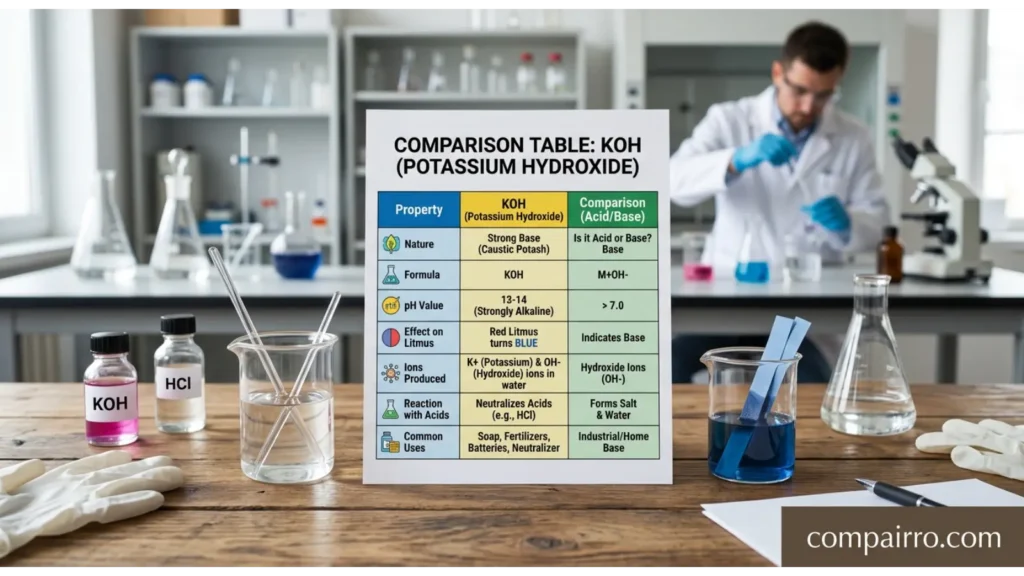
Comparison Table: KOH Acid or Base
| Feature | KOH |
|---|---|
| Full name | Potassium hydroxide |
| Formula | KOH |
| Type | Base |
| Strength | Strong base |
| Main ion produced in water | OH⁻ |
| pH of its aqueous solution | Greater than 7 |
| Common name | Caustic potash |
| Acid-base role | Base |
| Reaction with acid | Neutralization |
| Example acid | HCl |
KOH in Professional Life
KOH has several important professional and industrial uses.
It is used in chemical manufacturing, where it can act as a strong alkaline chemical. It is also used in producing certain soaps and other potassium-based compounds.
KOH can also be used in some battery and industrial applications. In laboratories, chemists use it when a strong alkaline solution is needed.
Because KOH is corrosive, professional users follow safety procedures. Protective equipment and proper chemical handling are important when working with concentrated KOH.
KOH for Students or Beginners
Many students struggle with KOH because they try to memorize formulas without understanding what happens in water.
A better approach is to focus on the ions.
When KOH dissolves in water:
KOH → K⁺ + OH⁻
The OH⁻ ion is the key.
Easy learning tips
- Remember that KOH contains OH⁻.
- Learn that KOH is a strong base.
- Compare it with common acids such as HCl.
- Practice simple neutralization equations.
- Remember that a basic aqueous solution has a pH above 7.
You do not need to memorize a long explanation. Understanding the hydroxide ion makes the concept much easier.
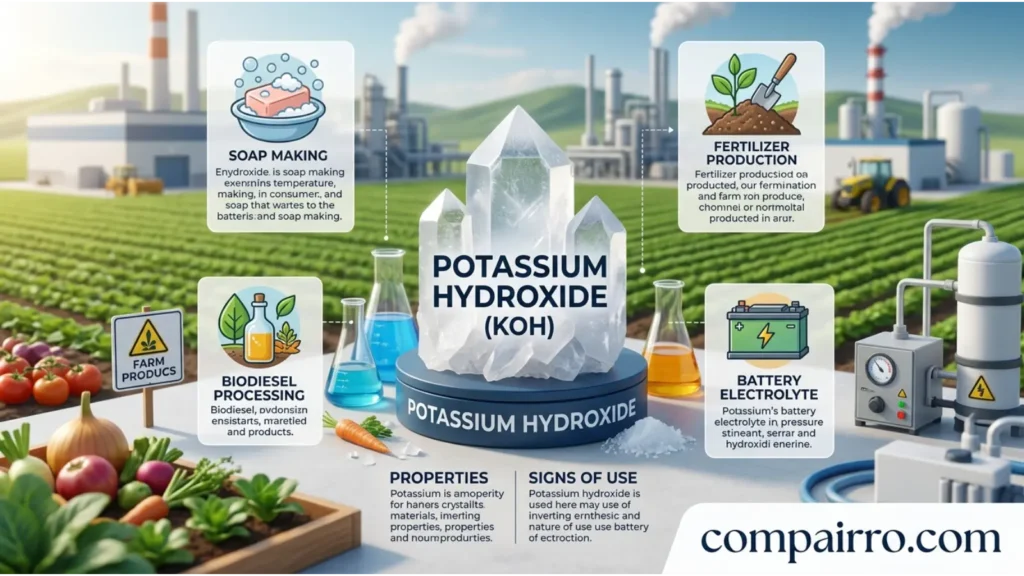
Signs or Characteristics Related to KOH
Here are the main characteristics that help identify KOH:
- It is a strong base.
- Its chemical formula is KOH.
- Its full name is potassium hydroxide.
- It produces OH⁻ ions in water.
- Its aqueous solution is alkaline.
- Its solution has a pH above 7.
- It can react with acids.
- It is highly corrosive in concentrated form.
- It is commonly used in industrial and laboratory processes.
- It can take part in neutralization reactions.
These properties make KOH an important example when learning about bases.
Simple Trick to Remember KOH
Here is an easy memory trick:
👉 KOH → OH → Base
The OH⁻ ion is the important clue.
Think of it this way:
KOH → gives OH⁻ → basic solution
Compare it with:
HCl → gives H⁺ → acidic solution
So, if you see KOH in a chemistry question, remember:
👉 KOH = Potassium Hydroxide = Strong Base
FAQs:
1. Is KOH an acid or base?
KOH is a strong base. It produces hydroxide ions (OH⁻) when dissolved in water.
2. Is KOH a strong or weak base?
KOH is a strong base because it dissociates almost completely in water.
3. What is the full form of KOH?
KOH stands for potassium hydroxide.
4. Why is KOH considered a base?
KOH is considered a base because it produces OH⁻ ions in aqueous solution.
5. Is KOH alkaline?
Yes. A solution of KOH in water is alkaline, meaning it has basic properties.
6. What happens when KOH reacts with HCl?
KOH reacts with HCl in a neutralization reaction:
KOH + HCl → KCl + H₂O
7. Is KOH dangerous?
Concentrated KOH is highly corrosive and can cause serious chemical burns. It should be handled using proper safety precautions.
Conclusion
So, is KOH an acid or base? The simple answer is that KOH is a strong base. Its full name is potassium hydroxide, and it produces OH⁻ ions when dissolved in water.
The easiest memory rule is:
👉 KOH → OH⁻ → Base
KOH is different from acids such as HCl, although both can take part in chemical reactions with each other. When KOH reacts with an acid, it can form salt and water through neutralization.
Once you remember that KOH is a strong base and produces hydroxide ions, most basic questions about KOH acid or base become much easier.

Sara Taylor is a passionate English content writer who specializes in word meanings, spelling comparisons, and modern slang explanations. She creates easy-to-understand articles that help readers avoid common English mistakes and improve their writing skills. Her content focuses on simple learning, real-life examples, and clear explanations for everyday readers.